
Date
2026/01/08
Organisations
Department of Primary Industries and Regional Development
GRDC
Authors
Bridget Watkins
Alice Butler

Key messages
- Alleviating soil compaction alone, or compaction and acidity together, to a depth of 45 cm enhanced plant root development, water use and overall crop performance in highly compacted, acidic sandy loam.
- Where lime was used in combination with soil loosening, nutrient uptake also increased.
- Compaction was more prohibitive than acidity on wheat root development and crop performance in this environment.
- Restricting root growth to depth promotes lateral root growth and increases competition among plants for limited water and nutrient resources in the upper soil layers, resulting in a reduction in yield.
- Promoting crop root development and exploration to depth can significantly impact the plant’s ability to thrive in water and nutrient-limited soils.
Context
Crop root growth is influenced by the chemical and physical properties of the soil. Low soil pH (soil acidity) can result in higher concentrations of aluminium in the soil solution which negatively impacts root growth as it prevents root cell division and elongation. The extractable aluminium concentration (EAC) in soil solution increases exponentially when subsoil pHCa is less than 4.5. Aluminium is toxic to the roots of sensitive plants at a concentration of 2–5 mg/kg soil, and tolerant plants when above 5 mg/kg soil. In addition, the availability of several critical plant nutrients (nitrogen, phosphorus, potassium and sulfur) is reduced in acidic soils.
High soil strength (compaction) physically forces plant roots to grow horizontally, limiting exploration and access to water and nutrition deeper in the soil profile. The growth of plant roots starts to be restricted at soil penetration strengths of 1.5 MPa and is severely restricted at 2.5 MPa. Compacted and acidic soils tend to have plants with more lateral roots and less root hairs which can restrict nutrient uptake. In rainfed broadacre cropping systems having access to soil water stored throughout the soil profile after flowering is critical for grain filling.
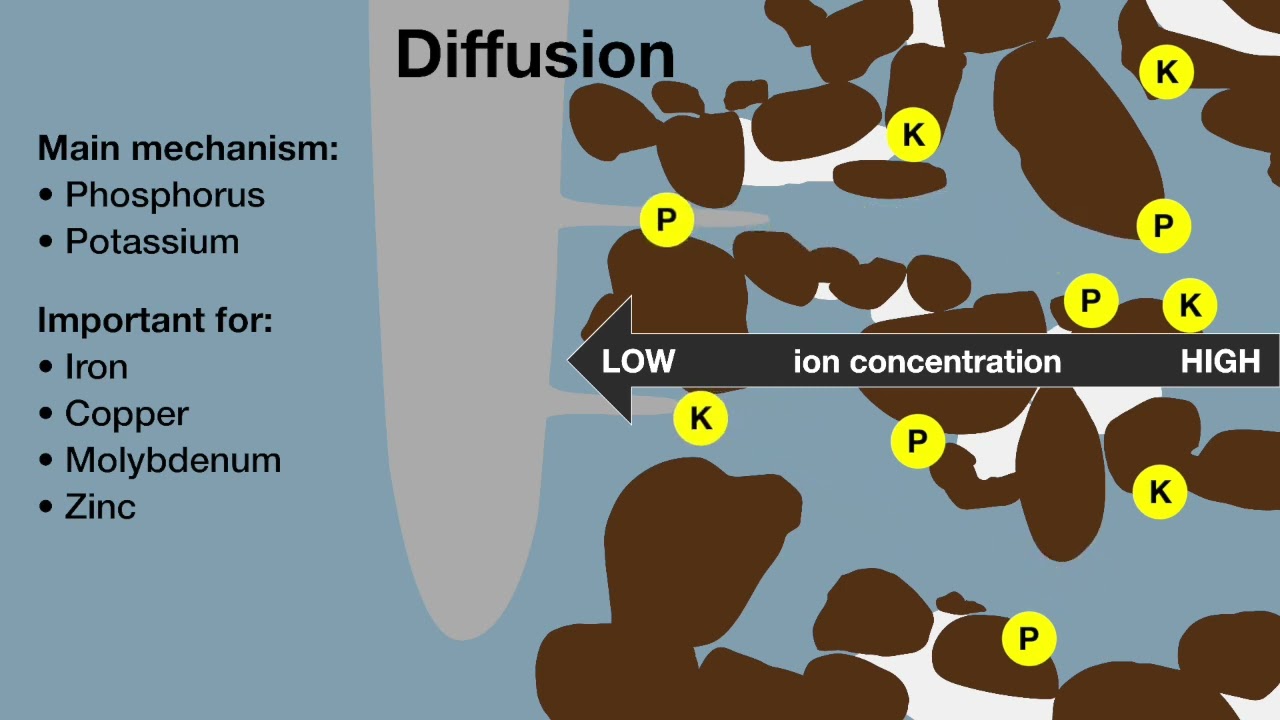
In nutrient deficient situations, plants allocate more energy to growing root biomass to allow for greater exploration for sufficient nutrition. However, this can result in reduced energy available for above-ground biomass, less tillers and reduced grain development.
Trial methods
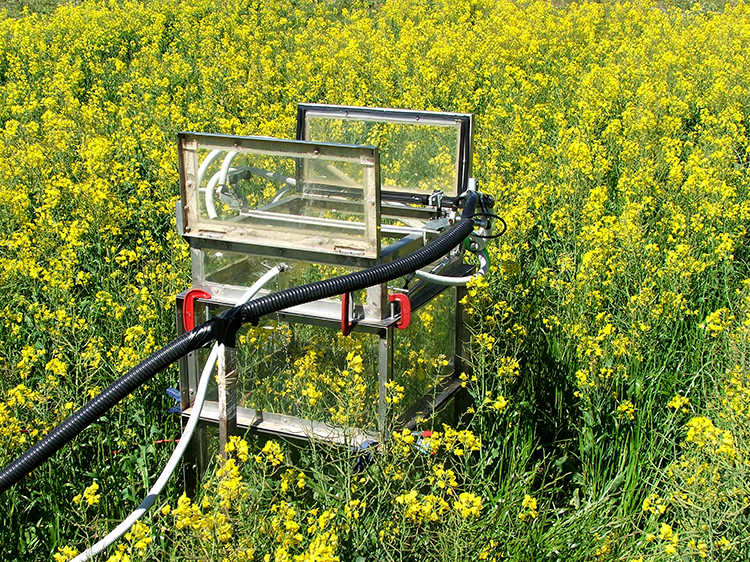
- Trial site: Kalannie, Western Australia
- Year: 2018
- Soil texture: Sandy loam (87% sand, 2% silt, 11% clay)
- pHCa : 4.4 (0–15 cm), 4.0 (20–40 cm)
- Soil strength: ~ 3.5 MPa (20–50 cm)
- Extractable aluminium concentration (EAC at 20-40 cm depth): 22 mg/kg
- Trial treatments comprised:
- Control (no lime or loosening)
- Soil loosening to a depth of 45 cm
- Soil loosening to a depth of 45 cm combined with incorporation of 6 t/ha lime to 45 cm
- Layers of soil (0-10 cm, 10-30 cm, 30-45 cm) were removed and stockpiled separately. Lime was incorporated with a rotary hoe with the return of each layer – 1.5 t/ha for 30-45 cm, 3 t/ha for 10–30 cm and 1.5 t/ha for 0–10 cm.
- Crop: Wheat, variety Scepter
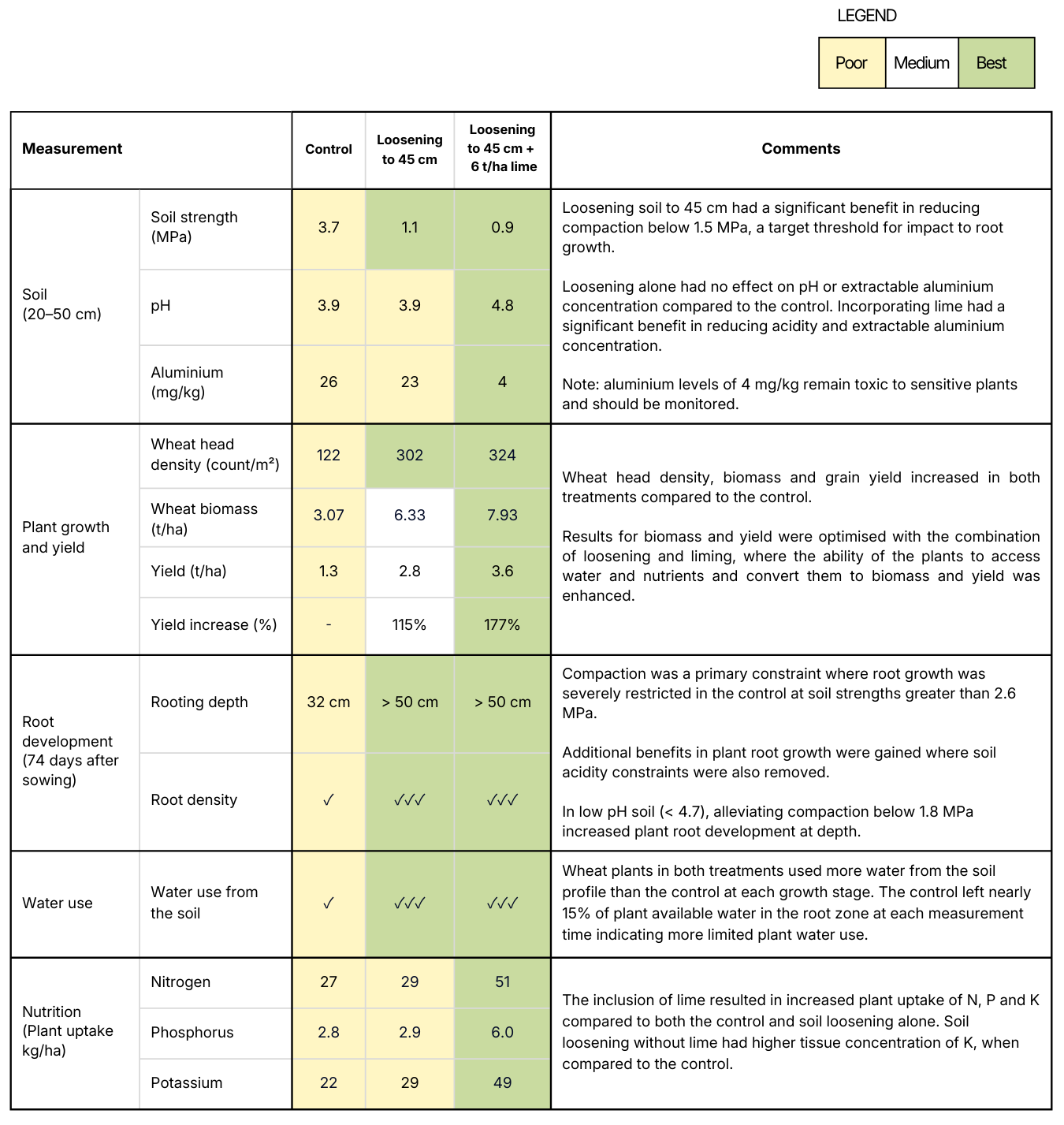
Results summary
The key findings are summarised below.
Page references and acknowledgements
Research summary developed from: Azam, G., Wickramarachchi, K., Scanlan, C., & Chen, Y. (2025). Deep and continuous root development in ameliorated soil improves water and nutrient uptakes and wheat yield in water-limited conditions. Plant and Soil, 512(1), 1405-1420. https://doi.org/10.1007/s11104-024-07153-0
Summary written by SW WA Regional Soil Coordinator Bridget Watkins, Murdoch University and Alice Butler, DPIRD; reviewed by Gaus Azam, DPIRD and Fran Hoyle, Murdoch University.
Contact: [email protected]
Article produced with investment from DPIRD and GRDC in the Soil Water and Nutrition (SWAN) Strategic Collaboration, DAW2407-001SPX extending research undertaken by DPIRD and GRDC investments DAW1902-003RTX and DAW00252.
SW WA Regional Soil Coordinator role is delivered by Murdoch University SoilsWest, led by the Grower Group Alliance’s South-West WA Drought Resilience Adoption and Innovation Hub and supported by the Australian Government Department of Agriculture, Fisheries and Forestry through funding from the Climate-Smart Agriculture Program under the Natural Heritage Trust.