Project
SWAN CollaborationDate
2026/06/30
Organisations
Department of Primary Industries and Regional Development
Grains Research and Development Corporation
Authors
Bindi Isbister
Hasinur Rahman
Gaus Azam
Snapshot
Growers: Brad and Narelle Smith
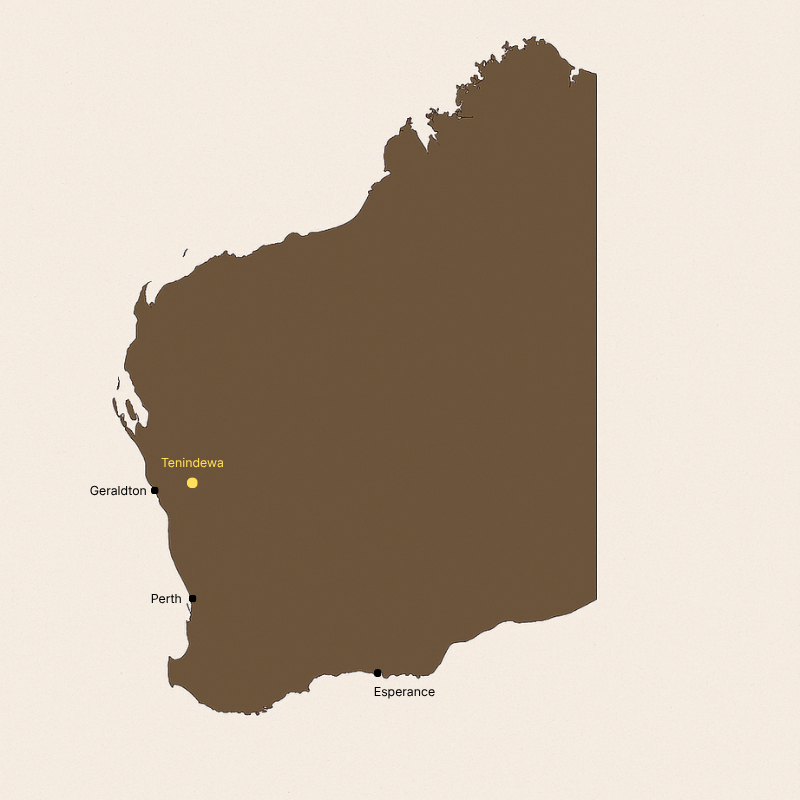
Location: Tenindewa, east of Geraldton
Enterprises: cropping (within a controlled traffic system)
Average annual rainfall: 294 mm
Average growing season rainfall: 226 mm
Soil types: yellow sand (fine, medium, coarse) and loam
Soil constraints: compaction and soil acidity
Amelioration process: deep ripping with topsoil inclusion plates and lime
Key messages
- Deep ripping to 45 cm with topsoil inclusion plates has increased grain yields and nearly doubled water use efficiency from a three-year average of 7 kg/ha/mm before amelioration (2013–2015) to 12 kg/ha/mm after amelioration (2020–2023).
- Topsoil inclusion down the rip line has created a pathway of higher soil pH which has, in turn, enabled more root growth through the compact, acidic subsoil – particularly in the medium and coarse deep yellow sands where low pH is also associated with aluminium toxicity.
- Four years after ripping, bulk density remains lower and organic carbon and root matter higher at 20–50 cm on the rip line than off the rip line.
- Quantifying the difference in soil properties on and off the rip lines will enable more accurate estimates of lime and fertiliser inputs going forward.
Background
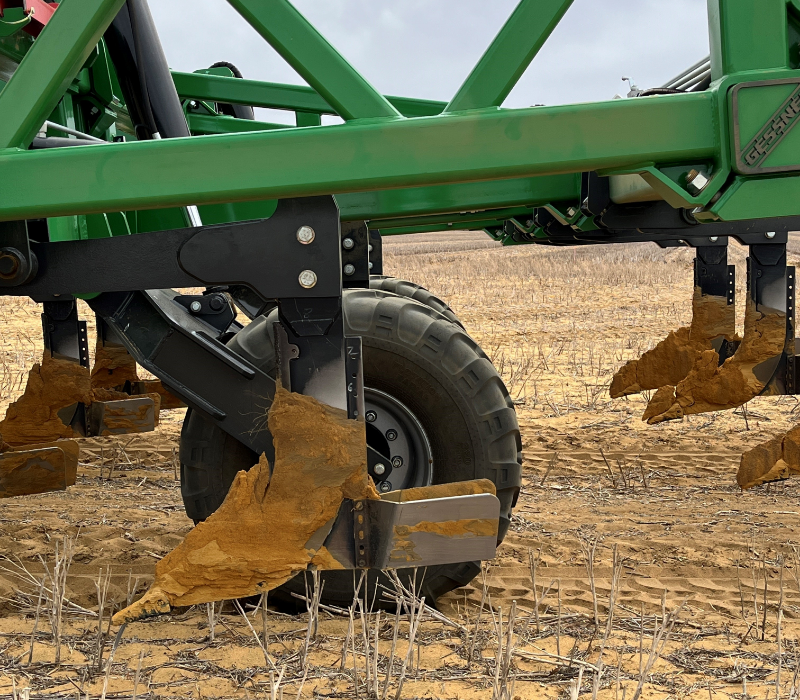
Topsoil inclusion is an enhanced form of deep ripping involving a pair of steel ‘opener’ plates bolted behind deep ripping tines, which are spaced to form side-shields (Figure 1). Cavities created by the deep ripping tines are expanded by the plates, enabling loose topsoil to fall over the top of the plates and into the loosened soil profile. Spreading lime prior to topsoil inclusion creates a channel of soil with higher organic matter and pH to the ripping depth, typically 45–60 cm. This channel of better-quality soil provides a pathway for crop roots through the subsoil, which is often constrained by subsoil acidity, compaction and low fertility, and enables the crop to access moisture and nutrients in the deeper subsoil (Parker and Isbister 2017).
In Western Australia, deep ripping with topsoil inclusion plates has been shown to increase crop yields on sandy soils by more than 50% (Davies et al. 2017). Deep ripping with topsoil inclusion has increased yields by up to one tonne more than standard deep ripping with better grain quality in dry seasons (Blackwell et al. 2016).
On yellow sands in the Geraldton region, deep ripping is commonly done every four years as ripped soil resettles after time. This resettling occurs even when controlled traffic is used and increases soil penetration resistance, restricting plant root growth. Brad uses a fibre glass rod as a makeshift penetrometer to indicate the depth of hard pan in the winter before ripping. He does this to determine if the soil has recompacted to the point of needing to be ripped again.
Case study paddock
The case study paddock was originally two adjacent paddocks (A9 and A10) treated the same agronomically but limed (2.5 tonnes/ha) and deep ripped with topsoil inclusion in different seasons (2016 and 2017) (Figure 2). In 2020, both paddocks were deep ripped again with topsoil inclusion to 45 cm. This ripping was in the same direction as all paddock operations.
The rip lines were 60 cm apart with sowing done on 32 cm rows and subsequent crops sown in the interrow of the previous crop.
This case study examines the impacts of soil amelioration on paddock performance since 2020.
The case study paddock(s) were zoned according to soil type using EM 0–150 cm and gamma total counts in 2012. Three soil types were mapped – with each a variation on acidic deep yellow sand:
- Low yielding coarse sand (Zone 1)
- Medium yielding medium sand (Zone 2)
- High yielding fine sand (Zone 3).
Fertiliser has been applied at variable rates across all zones since 2013.
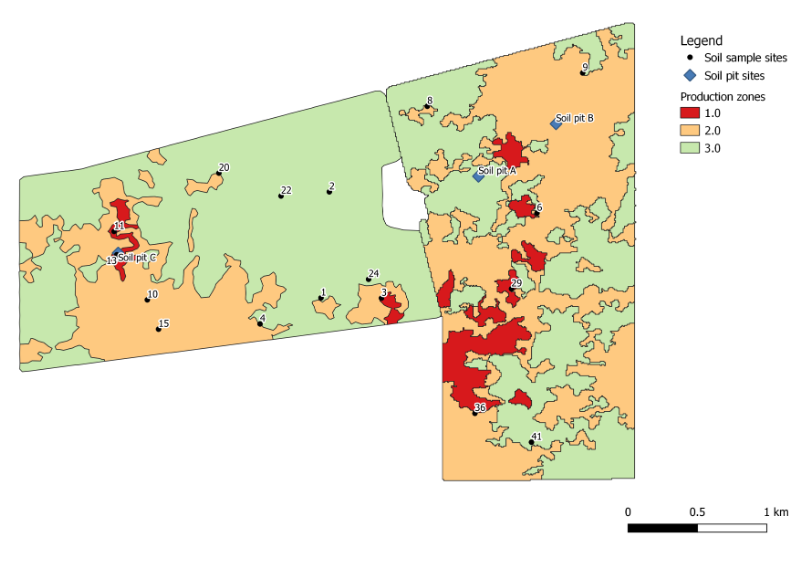
The case study paddock has been monitored for changes in soil properties and grain yield since 2020 using harvest yield maps from 2014 to 2023, and strategic soil testing at 17 sites across the paddock (see Figure 2 for soil sampling locations).
Results
Yield
Spatial and whole-paddock yield data was analysed over 10 years between 2013 and 2023 to determine the impact of soil amelioration across soil type zones (Figure 3). The yield maps show the increase in yield after each time of amelioration, particularly in 2016 when the western paddock (A9) was deep ripped while the western paddock (A10) was not.
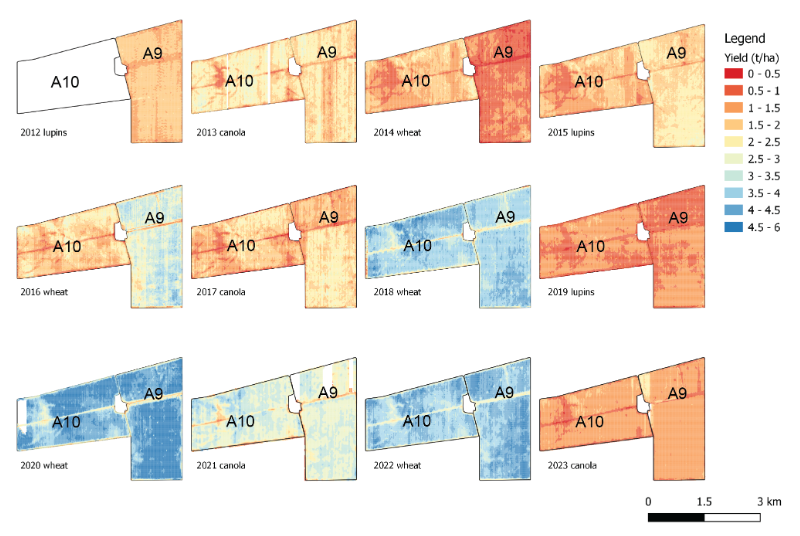
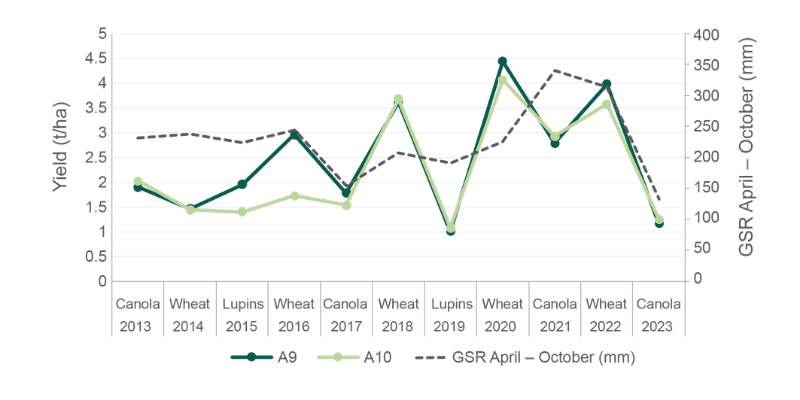
In 2015, A9 and A10 paddocks performed similarly (Figure 3). Following deep ripping of A9 in 2016, the average yield of A9 was about 1 t/ha higher than A10. When A10 was deep ripped in 2017, the average yield of A10 was similar to A9, indicating that deep ripping had removed the subsoil compaction (Figure 4).
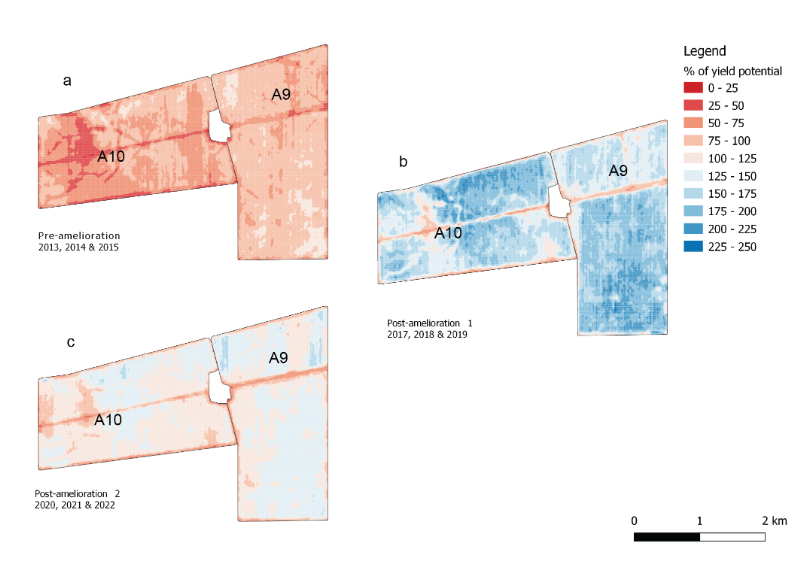
Potential yield is a calculation of total yield possible given the annual rainfall, with rainfall as the only constraint. The proportion of potential yield achieved is a measure of how close the actual paddock yield came to the calculated potential yield. Following ripping with topsoil inclusion plates, the proportion of potential yield achieved increased across 90% of the case study paddock (A9 and A10). This was particularly true in the low yielding coarse sand of Zone 1 as indicated by increased blue and less red in Figure 5.
Soil testing and pit exploration have subsequently shown the increase in yield potential achieved is due to removal of subsoil compaction and improvements in soil pH, aluminium levels, and organic carbon in the rip line.
Soil properties
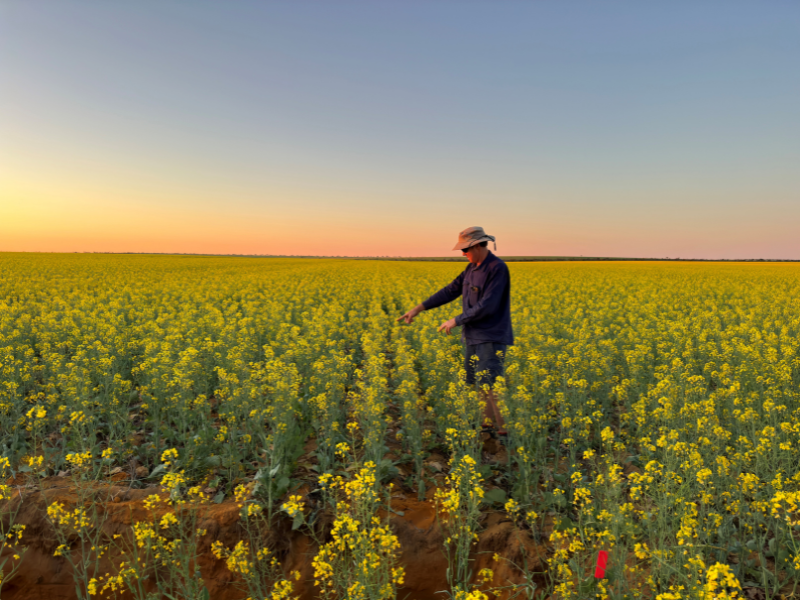
Paddock monitoring in July 2023 (a low rainfall season) showed a distinct difference in canola biomass between alternate crop rows. Closer inspection indicated the canola rows were on and off the rip lines (rip line spacing 60 cm and crop row spacing 31 cm) and that there was moisture in the rip line but not between the rip lines. In August 2023, a soil pit was dug in each of the soil-type production zones (Figure 6) to measure root abundance and soil properties on and off the rip line every 10 cm (Tables 1-4).
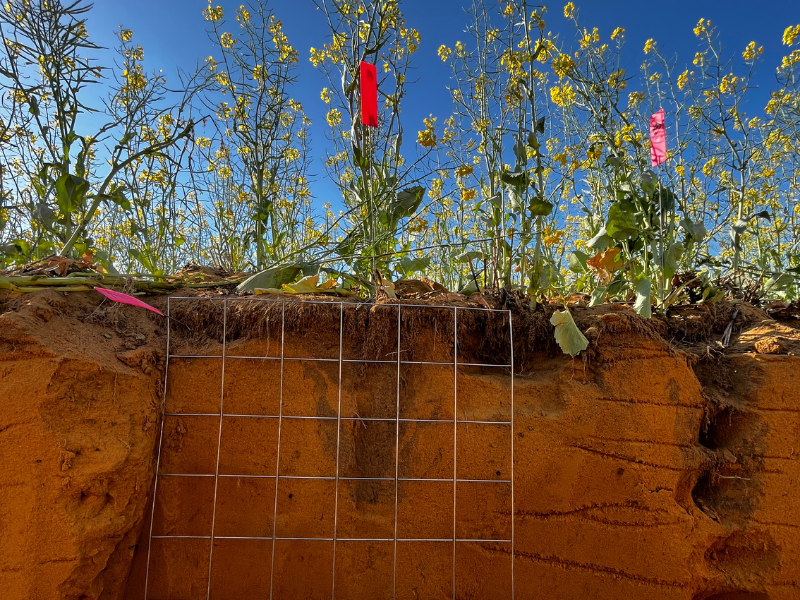
Across all soil types, root abundance at 0–10 cm did not differ on and off the rip line, but there was a significant increase in canola root numbers on the rip line from 10 cm in the medium sand (Site B) and the coarse sand (Site C) (Table 1). Below 50 cm on the coarse sand (Site C), no roots were found off the rip line. In the fine sand (Site A), root abundance did not differ between the ripped and unripped lines except in the 60–90 cm soil layer, where there were more roots on the rip line.
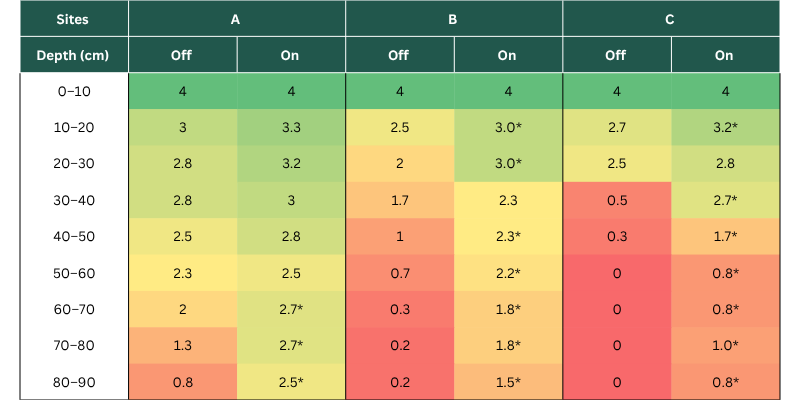
*p <0.05 significant difference off vs on rip line for each soil type/pit. Observations were taken 20 August 2023, 113 days after sowing. Note: Cell colours are graded based on value to indicate root abundance pattern not critical values. Green is abundant and red is few to zero. 0 = 0 roots, 1 = few, 2 = common, 3= many, 4 = abundant (McDonald, Isbell, and Biggs 2024).
Soil pH was significantly higher on the rip line than off the rip line at 20–50 cm in all soil types (Table 2). Soil pH increased below 50 cm at all three sites.
For the coarse sand (Site C), soil pH off the rip line below 10 cm was below the subsoil target pH (CaCl2) of 4.8 and was very acidic at 20–50 cm with a soil pH of 4.2–4.4; resulting in high aluminium levels at this depth of 6–9.1 mg/kg, which is highly toxic to root growth.
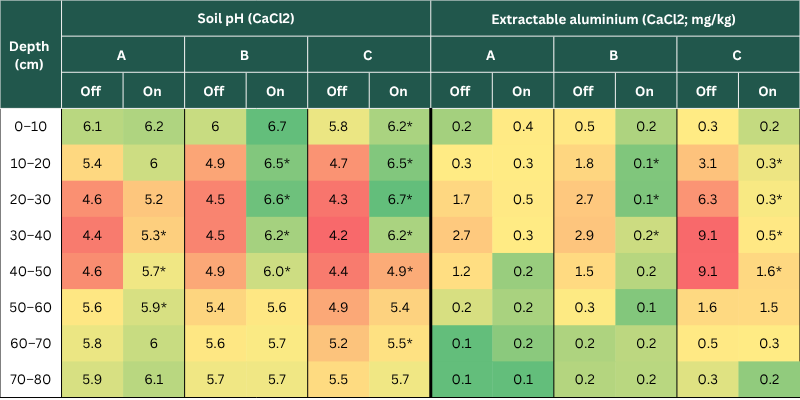
*p <0.05 significant difference off vs on for each soil type. Samples were taken 20 August 2023, 113 days after sowing. Note: Cell colours are graded based on value to indicate root abundance pattern not critical values, with green the highest and red the lowest.
Bulk density was lower on the rip line than off the rip line at 20–50 cm depths at all sites. At sites A and C, the bulk density was similar at 10–20 cm depth on and off the rip line; Site A was 1.3 g/cm3 and Site C 1.5 g/cm3 (Table 3). Of the three soil types, Site A (fine sand) had the lowest bulk density and Site C (coarse sand) had the highest. There was significantly less soil water on the rip line at Site A (30–40 cm) and Site B (20–30 cm) compared to off the rip line. There was significantly less soil water on the rip line at the 10–50 cm depth at Site C than off the rip line. Site C also had higher soil water on the rip line below 50 cm than the other two sites (Table 3).
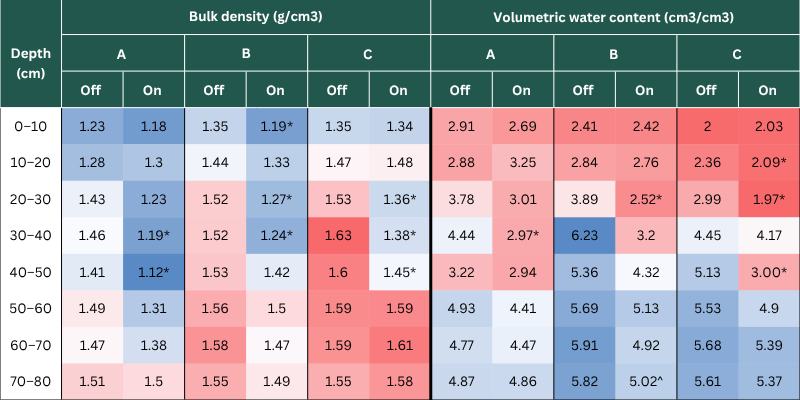
*p <0.05 significant difference on and off the rip line for each soil type. Samples were taken 20 August 2023, 113 days after sowing. Note: Cell colours are graded based on value and indicate pattern not critical values, with blue the lowest and red the highest.
There was significantly more organic carbon at 10–30 cm on the rip line at sites B and C (Table 4). There was no difference in organic carbon content below 50 cm (data not shown).
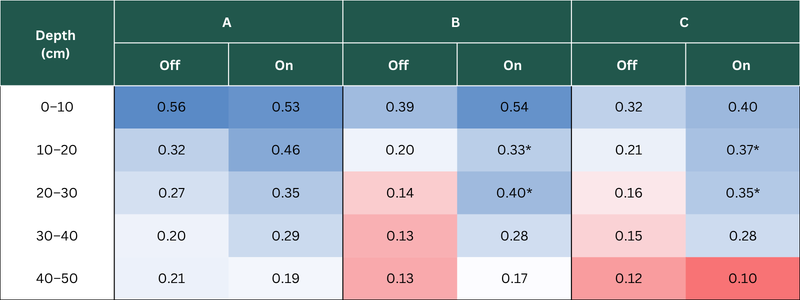
*p <0.05 significant difference off vs on for each soil type. Samples were taken 20 August 2023, 113 days after sowing. Note: Cell colours are graded based on value to indicate pattern not critical values, with blue the highest and red the lowest.
Financial analysis
Analysis of gross margins from 2013 to 2023 showed a strong financial benefit from deep ripping with topsoil inclusion. The impact of this tillage was most evident in 2016 when A9 (ripped) achieved a gross margin of $1500/ha almost $600/ha more than A10 (unripped) at $910/ha. Before amelioration, gross margins for paddock A9 averaged about $924/ha.
After the second amelioration in 2020, gross margin increased to more than $2000/ha for both paddocks, effectively more than doubling pre-treatment values.
However, unfortunately, deep ripping with topsoil slotting plates does not mitigate the low rainfall years with gross margin in low rainfall years (due to low yields) falling to pre-ripping values.
Lessons learned
- Deep ripping with topsoil soil inclusion has created pathways of improved soil pH, greater organic matter and reduced bulk density into the subsoil which has, in turn, increased yield and water use efficiency. The benefits are more pronounced in the medium and coarse sands where acidity and compaction previously limited root growth.
- Monitoring shows that the amelioration improvements persist for several years, and it is hypothesised that higher organic matter in the ameliorated areas is delaying resettling and recompaction of the subsoil.
- Topsoil inclusion moves lime down the soil profile instantly rather than waiting for lime to dissolve and leach from the surface into the soil profile. Brad’s long-term goal is to keep ripping along old rip lines to try and move the topsoil channel deeper each year.
- Soil conditions are critical to the success of topsoil inclusion. Topsoil must be dry before ripping to ensure the soil flows freely behind the tines. In moist soil, clay sticks to the rippling plates and reduces inclusion efficiency while increasing the pull on the tractor.
- A reduced speed of operation improves the efficiency of topsoil inclusion, allowing topsoil to fall deeper into the slot behind the tine. However, this requires patience and reduces the number of hectares ripped in a day. Brad achieves about 30 hectares a day in such circumstances.
- A roller is needed behind the deep ripper to level out the ridges caused by the deep ripping and provide an even seedbed.
- There have been issues with the sprayer falling off the tramlines into soft soil following deep ripping. Brad has mitigated this by winding the sprayer wheels out, so that they sit just off the tramline, but the longer-term plan is to replace the 480 mm tyres with 510 mm tyres to get better flotation. He also fitted wider flotation tyres to their 24 m Bourgault 5710 Air Hoe drill seeder bar to reduce bogging in soft soil and maintain consistent seeding depth.
Next steps
Brad plans to rip deeper to 70 cm to remove the last of the hard pan.
He has built a new ripper that will allow him to move the tines up to 30 cm along the toolbar, meaning he can rip between previous rip lines without going off the tramlines. The plan is to re-rip the old rip lines first (to deepen the inclusion depth) and then rip out in between the rip lines. He has established a large-scale ripping trial to evaluate the benefits and costs of ripping between old rip lines for amelioration of more of the soil profile.
For more information
Bindi Isbister
Research Scientist
Soil Productivity
Grains Research and Innovation
Department of Primary Industries and Regional Development
E: [email protected]
P: (08) 9956 8555
References
Blackwell P, Isbister B, Riethmuller G, Barrett-Lennard E, Hall D, Lemon J, Hagan J and Ward P (2016)
Deeper Ripping and Topsoil Slotting to Overcome Subsoil Compaction and Other Constraints More Economically: Way to Go! GRDC Grains Research Update, Perth, Western Australia.
Davies S, Parker W, Blackwell P, Isbister B, Betti G, Gazey G and Scanlan C (2017)
Soil Amelioration in Western Australia – What Techniques are Providing Benefits? GRDC Grains Research Update, Adelaide, South Australia.
Parker W, Isbister B, Hall D, McDonald G, Riethmuller G and Blackwell P (2017)
Longevity of Deep Ripping and Topsoil Inclusion in Soils Under Traffic Farming; Evidence from the Second Season. GRDC Grains Research Update, Perth, Western Australia.
McDonald RC, Isbell RF, Biggs JG.
“Soil Profile”, in Australian Soil and Land Survey Field Handbook. Edited by the National Committee on Soil and Terrain, 4th ed., CSIRO Publishing, 2024, pp. 121-175.
Acknowledgements
The research outlined in this case study was jointly funded by GRDC and DPIRD as part of the DAW1902-003RTX project Re-engineering Soils to Improve the Access of Crop Root Systems to Water and Nutrients Stored in the Subsoil and the DAW2401-001SPX project Soil Water and Plant Nutrition.